GWP
88,777.43kg CO₂ eq
The emissions of 1,000 cars on the road for a week.
Estimating 4.6 t of CO₂ per car per year.
An imported desulfurisation basket, made here: the same function, better performance and a system that takes it back to the tower.
Bio4 2021-2026, across 283,272 baskets.
GWP
88,777.43kg CO₂ eq
The emissions of 1,000 cars on the road for a week.
Estimating 4.6 t of CO₂ per car per year.
Water
317,767.14L
The domestic water of 3,178 people for a day.
Estimating 100 L per person per day.
Fossil energy
3,619,880.12MJ
The electricity used by 40 large concerts.
Estimating 26,400 kWh per event.
We visited the client to get inside the production process, understand how the biogas towers work and what the part does inside them.
We met a large team and worked with them to map the needs of every area. We got hold of one of the baskets they were using.
Through a technical analysis focused on high-efficiency injection moulding:
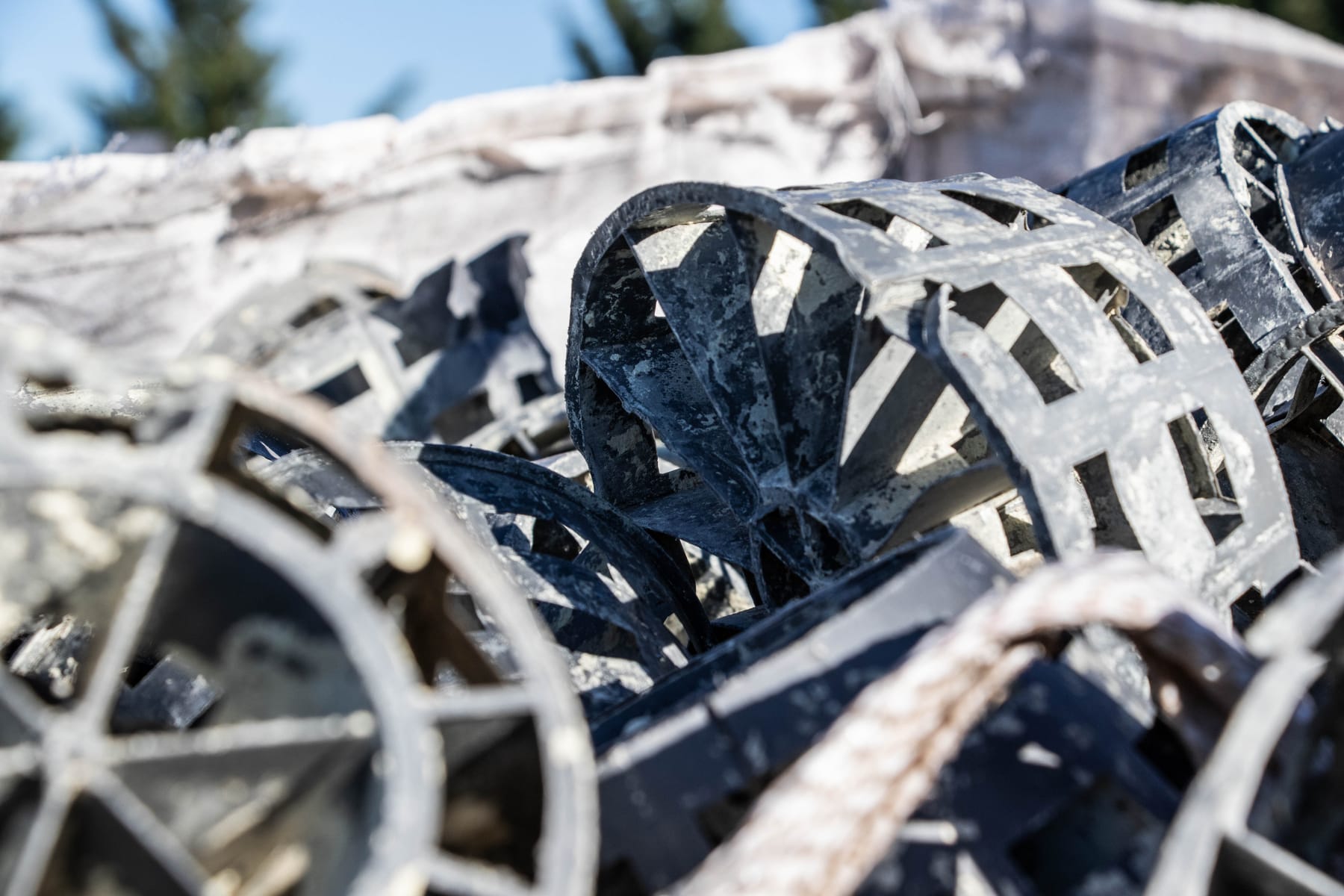
A unit price equal to the imported part, without the logistics and tax costs that importing carried.
A mould designed for recycled plastic, which avoids extracting virgin resources, and local labour for both the tooling and the production.
It is made from recycled raw material and shipped in reusable big bags, recovered from an activity that no longer needed them.
After being used in the tower, the Bio4 team takes the baskets out, cleans them —removing the sulfur that did not stick to the part— and puts them back for a new biogas run.
The cycle repeats as many times as possible: only worn or broken units are set aside. Three quarters of the tower is filled with reused baskets and one quarter with new ones.
Making a desulfurisation basket locally: a part that already existed and was imported, without losing function or quality, and improving its environmental impact at the same time.
Bringing it into its system: looking at how it is used, how long it lasts and what happens at the end of its life.
Biogas accounts for less than 1% of the national power generation mix: 82% of the energy sector is dominated by fossil fuels.
By law, the mandatory blend is 12.5% for biodiesel and 12% for bioethanol, split evenly between sugar cane and maize.
82%
of the energy sector is fossil fuels
12.5%
mandatory biodiesel blend
30%
how far the blend goes in Brazil
