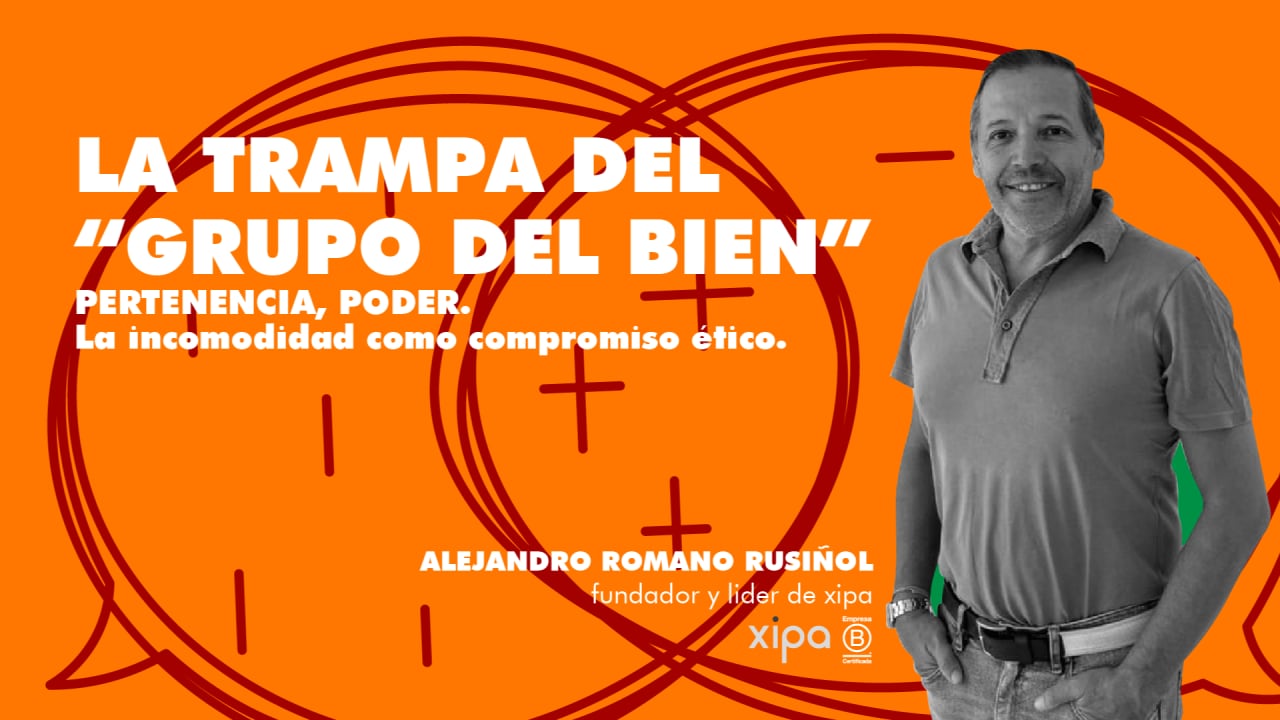
The “good group”, which is not that good.
28 January 2026 · Alejandro Romano Rusiñol, Founder and head of Xipa
There is a form of power that is not exercised by imposing, but by granting belonging. In the world of impact that power does not punish: it absolves.
Hannah Arendt warned that the greatest ethical danger is not conscious evil, but the suspension of critical thinking in the name of a cause perceived as just. Something of that happens when “good” stops being an uncomfortable question and becomes an identity.
In the triple-impact ecosystem, something has been consolidating as one more space of what we might call the good group.
It is not a formal group, but a symbolic border: you enter through certain achievements, discourses, certifications and shared languages. Once inside, something changes.
It is not that we stop producing negative impact. That would be naive to think. What happens is subtler: we start looking at it with less demand.
There are proposals —including some we develop at Xipa— whose positive impact is not inherent but conditional. They exist only if certain conditions of use, context and system are met. When those conditions are not met, the impact can be neutral or even negative.
A concrete example: a reusable eco-cup or eco-bag needs to replace a minimum number of disposables for its environmental balance to be, at least, neutral, and only from there positive. If that threshold is not reached —because of the design of the system, habits of use or the context in which it is implemented— the impact gets worse, even when the object is called “eco”.
If eco-cups or eco-bags with no real use pile up in our kitchens, events or companies, it is clear that we are not achieving what we say we are after.
The problem appears when the name, the story or belonging to the “good group” replace the real verification of impact. Calling something “eco” does not automatically make it virtuous, in the same way that a good intention does not guarantee a good environmental result.
Michel Foucault explained that the most effective power is not the one that represses, but the one that organises what can and cannot be said. In this case, what is organised is judgement: inside the good group, harm is not denied, but it becomes explainable, justifiable, contextual. It loses urgency. It loses its name.
External criticism is tolerated. Internal criticism is uncomfortable. Because questioning from the inside does not put a project at risk; it puts an identity at risk. And every identity, when it feels threatened, tends to defend itself before revising itself.
Byung-Chul Han speaks of communities that no longer need coercion because they rest on positive self-affirmation. Something similar happens here: we present ourselves through our successes, through what validates us morally, through the cases that confirm we are still “on the right side”. Not because we hide the rest, but because the system learned not to ask for it.
The consequence is profound. Ethics starts to shift towards aesthetics. What a practice produces matters less, and how it is perceived within the ecosystem matters more. Good becomes a narrative of symbolic performance.
Bruno Latour insisted that complex problems are not solved from moral positions, but from networks of explicit responsibility.
When good crystallises as identity, it stops being a criterion. And when it stops being a criterion, it also stops transforming.
The risk is not being wrong. That is inevitable.
The risk is another one: becoming unable to hold the discomfort of revising what gives us belonging.
At this point a question inevitably turns inwards. The challenge that being a certified B Corp implies for us at Xipa: how to prevent that belonging from becoming anaesthesia. How to make the certification work not as symbolic armour, but as a permanent demand for revision, discomfort and learning. It is partly our responsibility and also Sistema B’s.
Because every community that conceives of itself as “the good” develops, sooner or later, a structural blindness. Not to external evil, but to its own capacity to do harm.
Perhaps the action this time asks of us is not collective in the usual sense, but individual within the collective. Taking back the personal responsibility of thinking, even when thinking makes the group uncomfortable. Daring to say what unsettles, above all in the spaces that look after us the most. Resisting the temptation of moral applause and symbolic performance. Accepting that transforming systems means giving up certainties, stories and positions.
Perhaps the ethical commitment today does not consist of doing more, but of risking something: a comfortable story, an automatic validation, an unquestioned belonging.
Not to destroy what has been built, but to keep good from becoming a refuge.
I have no invitation to make; in fact I have more questions than certainties. An article for a seven-minute read that took me several months of reflection.
